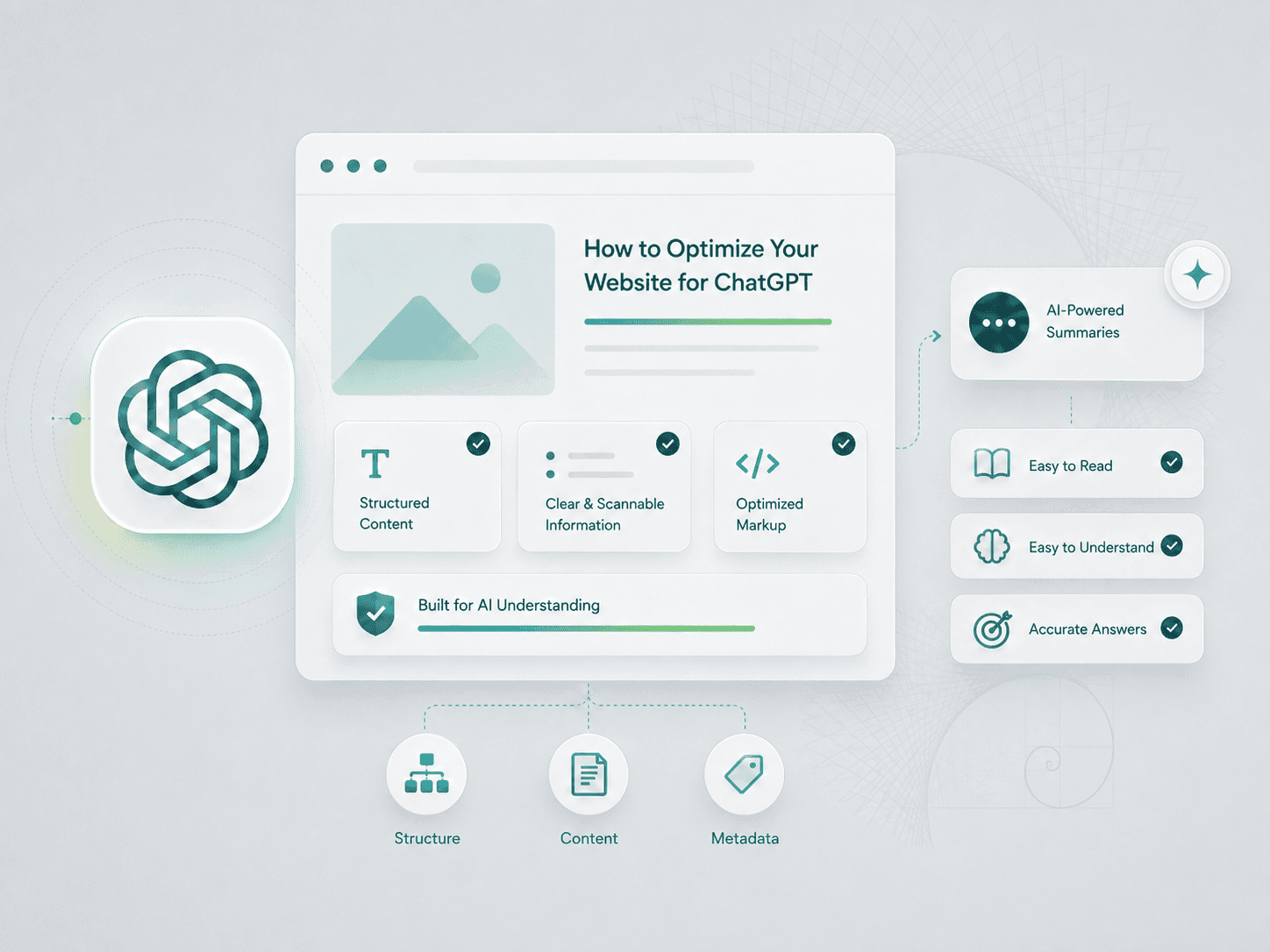
AI SEO Audit Checklist: Evaluate Your AI Search Readiness

AI SEO Audit Checklist: Evaluate Your AI Search Readiness

Most SEO audits still check for things Google cared about five years ago — but AI crawlers, AI Overviews, and tools like ChatGPT and Perplexity look for different signals entirely. An AI SEO audit checks whether your site can actually be crawled, understood, and cited by these systems, not just whether it ranks. This checklist walks through exactly what to evaluate.

Submit an Inquiry

Quick Answer

An AI SEO audit checklist evaluates whether AI crawlers can access and understand your site, and whether it's structured to get cited in AI-generated answers. That means checking robots.txt for blocked bots like GPTBot, PerplexityBot, and Google-Extended, adding an llms.txt file, and confirming indexing in Search Console and Bing Webmaster Tools. It also covers entity and content-specific schema, clear answer-first content structure, Core Web Vitals, and tracking how often your brand actually gets mentioned or cited across AI platforms.

How an AI SEO Audit Works

Gemini doesn't work like a single system — it's a retrieval process layered on top of Google's existing ranking infrastructure, and understanding that layering is the starting point for everything else here.

What an AI SEO Audit Actually Checks

  • Whether AI crawlers can reach and read your site at all — the layer traditional audits often skip

  • Whether your content and markup give AI systems enough structure to extract a confident answer

  • Whether your brand is actually showing up, and being cited correctly, in AI-generated responses

What an AI SEO Audit Actually Checks

  • Whether AI crawlers can reach and read your site at all — the layer traditional audits often skip

  • Whether your content and markup give AI systems enough structure to extract a confident answer

  • Whether your brand is actually showing up, and being cited correctly, in AI-generated responses

The Audit Process

Crawl Access → Structured Data → Content Clarity → Citation Tracking

  • Crawl access: confirm AI bots aren't blocked and your site is indexed

  • Structured data: confirm schema gives machines explicit facts about your entities and content

  • Content clarity: confirm answers are stated directly and structured logically

  • Citation tracking: confirm you can measure whether any of the above is actually translating into AI visibility

The Audit Process

Crawl Access → Structured Data → Content Clarity → Citation Tracking

  • Crawl access: confirm AI bots aren't blocked and your site is indexed

  • Structured data: confirm schema gives machines explicit facts about your entities and content

  • Content clarity: confirm answers are stated directly and structured logically

  • Citation tracking: confirm you can measure whether any of the above is actually translating into AI visibility

Want an expert to run this full audit on your site? Explore our AI SEO services →

Key Factors That Determine AI Search Readiness

Bot Accessibility & Indexing

  • robots.txt must not block GPTBot, PerplexityBot, Claude-SearchBot, or Google-Extended

  • An llms.txt file at the domain root gives AI systems a structured summary of your site

  • Verification in both Google Search Console and Bing Webmaster Tools confirms real-time indexing

Bot Accessibility & Indexing

  • robots.txt must not block GPTBot, PerplexityBot, Claude-SearchBot, or Google-Extended

  • An llms.txt file at the domain root gives AI systems a structured summary of your site

  • Verification in both Google Search Console and Bing Webmaster Tools confirms real-time indexing

Content Clarity & Answer Engine Optimization

  • A direct answer — a "content capsule" — stated within the first 30% of the content

  • Content matched to user intent, not just a target keyword

  • Every factual claim backed by a cited, high-quality external source

  • A single H1 per page, with H2s and H3s organizing content logically — the same discipline covered in Answer Engine Optimization

Content Clarity & Answer Engine Optimization

  • A direct answer — a "content capsule" — stated within the first 30% of the content

  • Content matched to user intent, not just a target keyword

  • Every factual claim backed by a cited, high-quality external source

  • A single H1 per page, with H2s and H3s organizing content logically — the same discipline covered in Answer Engine Optimization

Brand Mentions & AI Citations

  • Benchmark how often your brand is mentioned or cited in AI-generated answers against competitors

  • Reclaim unlinked or unbranded mentions by reaching out to site owners — a core piece of AI citation optimization

Brand Mentions & AI Citations

  • Benchmark how often your brand is mentioned or cited in AI-generated answers against competitors

  • Reclaim unlinked or unbranded mentions by reaching out to site owners — a core piece of AI citation optimization

Schema Markup & Structured Data

  • Entity schema (Organization, Person, LocalBusiness) tells machines who's behind the content — see the full structured data for AI search guide for implementation details

  • Content schema (Article, FAQPage, HowTo) helps AI models extract answers directly

  • Author bios linked to an About page, included in post schema, establish trust

Schema Markup & Structured Data

  • Entity schema (Organization, Person, LocalBusiness) tells machines who's behind the content — see the full structured data for AI search guide for implementation details

  • Content schema (Article, FAQPage, HowTo) helps AI models extract answers directly

  • Author bios linked to an About page, included in post schema, establish trust

Technical Performance

  • Page load under 2.5 seconds on both desktop and mobile

  • Interaction to Next Paint (INP) under 200 milliseconds

  • Cumulative Layout Shift (CLS) under 0.1

  • Fully responsive design with properly scaled tap targets and text

Technical Performance

  • Page load under 2.5 seconds on both desktop and mobile

  • Interaction to Next Paint (INP) under 200 milliseconds

  • Cumulative Layout Shift (CLS) under 0.1

  • Fully responsive design with properly scaled tap targets and text

Steps to Run an AI SEO Audit

What an AI SEO Audit Actually Checks

Check robots.txt for anything blocking GPTBot, PerplexityBot, Claude-SearchBot, or Google-Extended, then confirm indexing status in Search Console and Bing Webmaster Tools before touching anything else — none of the later steps matter if AI crawlers can't reach the site.

What an AI SEO Audit Actually Checks

Check robots.txt for anything blocking GPTBot, PerplexityBot, Claude-SearchBot, or Google-Extended, then confirm indexing status in Search Console and Bing Webmaster Tools before touching anything else — none of the later steps matter if AI crawlers can't reach the site.

Check Schema and Structured Data Coverage

Review which pages have entity schema (Organization, Person, LocalBusiness) and which have content schema (Article, FAQPage, HowTo), then flag high-value pages missing either.

Check Schema and Structured Data Coverage

Review which pages have entity schema (Organization, Person, LocalBusiness) and which have content schema (Article, FAQPage, HowTo), then flag high-value pages missing either.

Review Content for Answer-First Structure

Check whether key pages state a direct answer early, cite sources for factual claims, and use a clean, logical heading hierarchy rather than burying the point three paragraphs in.

Review Content for Answer-First Structure

Check whether key pages state a direct answer early, cite sources for factual claims, and use a clean, logical heading hierarchy rather than burying the point three paragraphs in.

Benchmark Brand Citations Against Competitors

Run a fixed set of prompts across ChatGPT, Perplexity, and Google AI Overviews to see how often your brand appears relative to named competitors, then track that number over time rather than treating it as a one-off check.

Benchmark Brand Citations Against Competitors

Run a fixed set of prompts across ChatGPT, Perplexity, and Google AI Overviews to see how often your brand appears relative to named competitors, then track that number over time rather than treating it as a one-off check.

Tools for an AI SEO Audit

Site Crawling & Technical Audits

Semrush's Site Audit and Screaming Frog both surface crawl errors, blocked resources, and indexing issues at scale, which is the fastest way to catch bot-accessibility problems across a large site.

Site Crawling & Technical Audits

Semrush's Site Audit and Screaming Frog both surface crawl errors, blocked resources, and indexing issues at scale, which is the fastest way to catch bot-accessibility problems across a large site.

Schema Validation

Google's Rich Results Test and the Schema Markup Validator confirm your entity and content schema are implemented correctly before they go live.

Schema Validation

Google's Rich Results Test and the Schema Markup Validator confirm your entity and content schema are implemented correctly before they go live.

ReviewCore Web Vitals & Performance Content for Answer-First Structure

Google's PageSpeed Insights and Search Console's Core Web Vitals report show exactly where load speed, INP, or CLS are falling short of AI-readiness thresholds.

ReviewCore Web Vitals & Performance Content for Answer-First Structure

Google's PageSpeed Insights and Search Console's Core Web Vitals report show exactly where load speed, INP, or CLS are falling short of AI-readiness thresholds.

AI Visibility & Citation Tracking

Manual prompt testing across ChatGPT, Perplexity, and Copilot, paired with brand monitoring tools, shows whether your brand is actually being mentioned or cited — and how that compares to competitors. Track this on a recurring basis rather than as a one-time check, since AI search responses shift over time and a single snapshot won't tell you whether you're gaining or losing ground.

AI Visibility & Citation Tracking

Manual prompt testing across ChatGPT, Perplexity, and Copilot, paired with brand monitoring tools, shows whether your brand is actually being mentioned or cited — and how that compares to competitors. Track this on a recurring basis rather than as a one-time check, since AI search responses shift over time and a single snapshot won't tell you whether you're gaining or losing ground.

Best Practices for AI SEO Audits

Check robots.txt for AI-Specific Crawlers

  • Most robots.txt files were never updated for GPTBot, PerplexityBot, or Google-Extended

  • A single overlooked disallow rule can quietly block an entire class of AI traffic

Add an llms.txt File

  • Gives AI systems a structured, easily readable summary of your site's content and capabilities

  • Sits at the domain root, similar in spirit to a sitemap

Verify Indexing in Both Google and Bing

  • Confirms real-time search engines are actually picking up your content

  • A well-written summary of common knowledge is easy to skip in favor of a source that says something more specific

Lead Content With a Direct Answer

  • State the answer within the first 30% of the page

  • AI systems extract concise, clear statements far more reliably than buried conclusions

Cite Sources for Every Factual Claim

  • Link to high-quality external sources within the relevant context

  • Supports the verification step AI systems run before citing a page

Structure Headings With a Single H1 and Logical H2/H3s

  • One H1 per page, with H2s and H3s organizing distinct sections

  • Clean hierarchy helps both crawlers and AI models parse the page's structure

AI SEO Audit Checklist

Crawlability & Indexing

  • robots.txt does not block GPTBot, PerplexityBot, Claude-SearchBot, or Google-Extended

  • An llms.txt file is in place, and the site is verified in both Search Console and Bing Webmaster Tools

Structured Data

  • Entity schema (Organization, Person, LocalBusiness) is implemented on core pages

  • Content schema (Article, FAQPage, HowTo) is applied where relevant, with author bios linked

Content & Technical Readiness

  • Key pages lead with a direct answer within the first 30% of content, with a single H1 and logical H2/H3s

  • Load speed is under 2.5 seconds, INP under 200ms, CLS under 0.1, and the site is fully mobile-responsive

Brand Visibility

  • AI citation frequency is benchmarked against named competitors on a recurring basis

  • Unlinked or unbranded mentions are being actively identified and reclaimed

Want a faster way to work through this checklist across your whole site? Get an AI SEO Audit

Common AI SEO Audit Mistakes

Auditing Only for Traditional SEO, Not AI Crawlers

Most legacy audits never check for GPTBot, PerplexityBot, or Claude-SearchBot specifically, which means a site can pass a traditional audit while still being invisible to AI systems.

Skipping the llms.txt File

It's new enough that most sites don't have one yet, but it's one of the few direct, structured ways to tell AI systems what your site actually offers.

Treating Schema as Optional

Entity and content schema aren't cosmetic — they're often the difference between an AI system confidently citing a page and skipping it for a better-structured competitor.

Never Benchmarking Citation Frequency

Without a recurring prompt-testing habit, there's no way to know whether audit fixes are actually improving AI visibility or just checking boxes.

Spending effort here is effort not spent on structure, entity signals, and genuinely useful content — the things that actually move the needle.

What an AI SEO Audit Catches in Practice

Blocked Crawler Example

A site's robots.txt disallows all bots matching a broad pattern, unintentionally blocking GPTBot and PerplexityBot along with unwanted scrapers — an audit catches this in minutes, while it could otherwise go unnoticed for months.

Missing Answer Capsule Example

A well-written blog post buries its actual answer in the fourth paragraph after several paragraphs of scene-setting — an audit flags it, and rewriting the opening to lead with the answer directly improves its extractability without changing the rest of the piece.

Unbenchmarked Citation Gap Example

A brand assumes it's visible in AI answers because it ranks well organically, but a prompt-testing pass shows a direct competitor being cited three times as often — a gap that would have stayed invisible without deliberate benchmarking.

Frequently Asked Questions

Frequently Asked Questions

Frequently Asked Questions

How is an AI SEO audit different from a traditional SEO audit?

A traditional audit focuses on rankings, backlinks, and keyword targeting. An AI SEO audit adds a layer specific to AI systems — bot accessibility, structured data, answer-first content, and citation tracking — since those are the signals AI platforms rely on that traditional audits don't check.

Ready to see exactly where your site stands on AI search readiness?

Ready to see exactly where your site stands on AI search readiness?

Ready to see exactly where your site stands on AI search readiness?

All Rights Reserved –  Copyright © 2018-2026 Fibonacci Agency

info@fibonacciagency.com

All Rights Reserved –  Copyright © 2018-2026 Fibonacci Agency

info@fibonacciagency.com

All Rights Reserved –  Copyright © 2018-2026 Fibonacci Agency

info@fibonacciagency.com