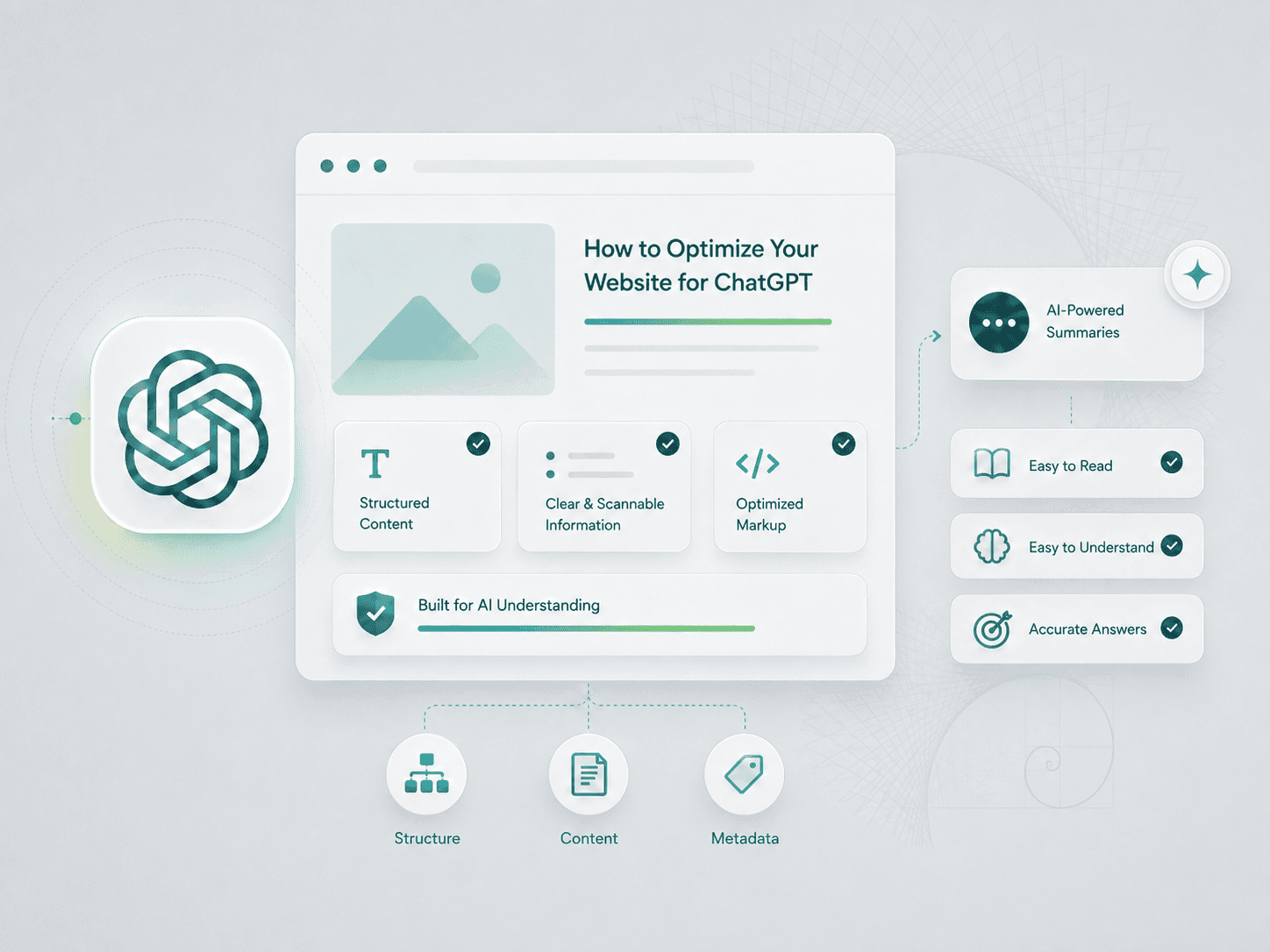
Entity SEO: Improve How AI Search Understands
Your Brand

Entity SEO: Improve How AI Search Understands
Your Brand

Search engines don't read your website the way people do. They break it down into distinct "things" — your brand, your services, the people behind them — and try to work out how those things relate to each other. Entity SEO is the practice of making that job easy: giving search engines and AI systems clear, consistent signals about who you are, instead of relying on keywords alone to get the point across.

Search engines don't read your website the way people do. They break it down into distinct "things" — your brand, your services, the people behind them — and try to work out how those things relate to each other. Entity SEO is the practice of making that job easy: giving search engines and AI systems clear, consistent signals about who you are, instead of relying on keywords alone to get the point across.

Let's Discuss Your AI Search Growth Strategy

Let's Discuss Your AI Search Growth Strategy

Let's Discuss Your AI Search Growth Strategy

Quick Answer

Quick Answer

Quick Answer

Entity SEO is the practice of structuring your website and brand presence so search engines and AI systems recognize your business, products, and services as distinct, well-defined "things" rather than strings of keywords. Both Google and AI platforms build their understanding of a topic from a knowledge graph — a network of entities and their relationships — rather than from exact-match text, which is why this overlaps so heavily with AI SEO and structured data for AI search. Get your entity signals right, and search engines can connect your brand to a much wider range of relevant queries than the exact words on your page.

How Entity SEO Works

How Entity SEO Works

How Entity SEO Works

How Search Engines Identify Entities

  • Break content into smaller units of meaning using natural language processing, rather than scanning for exact keyword matches

  • Match those units against an entity database — Google's Knowledge Graph is the best known, but Wikidata and Crunchbase serve a similar purpose

  • Disambiguate ambiguous terms using surrounding context — deciding whether "Apple" means the fruit or the company based on nearby words and links

  • Assign a unique identifier to confirmed entities, which is what allows a brand to appear in a Knowledge Panel

How Search Engines Identify Entities

  • Break content into smaller units of meaning using natural language processing, rather than scanning for exact keyword matches

  • Match those units against an entity database — Google's Knowledge Graph is the best known, but Wikidata and Crunchbase serve a similar purpose

  • Disambiguate ambiguous terms using surrounding context — deciding whether "Apple" means the fruit or the company based on nearby words and links

  • Assign a unique identifier to confirmed entities, which is what allows a brand to appear in a Knowledge Panel

How Entity Relationships Are Built

  • Extraction: Content is scanned for named entities — people, organizations, places, products.

  • Disambiguation: Each mention is matched to a specific, unique entity rather than left as a generic term.

  • Relationship Mapping: The entity is connected to related entities based on how often and how closely they appear together across the web.

  • Reinforcement: Consistent mentions across multiple trusted sources strengthen those connections over time.

How Entity Relationships Are Built

  • Extraction: Content is scanned for named entities — people, organizations, places, products.

  • Disambiguation: Each mention is matched to a specific, unique entity rather than left as a generic term.

  • Relationship Mapping: The entity is connected to related entities based on how often and how closely they appear together across the web.

  • Reinforcement: Consistent mentions across multiple trusted sources strengthen those connections over time.

Want a technical foundation that goes beyond entity signals alone?

Key Factors That Shape Entity Recognition

Key Factors That Shape Entity Recognition

Key Factors That Shape Entity Recognition

Not every signal carries equal weight. The factors below are the ones that consistently determine whether search engines and AI systems can confidently identify your brand as a distinct, well-defined entity — and they're also the ones most within your direct control.

Structured Data and Schema Markup

• Gives search engines explicit, machine-readable facts instead of leaving them to infer meaning

• Types like Organization, Person, and Product remove ambiguity fastest

Digital Consistency Across the Web

• Name, address, and phone number (NAP) need to match across your site, directories, and social profiles

• Inconsistency makes it harder for a knowledge graph to confirm you're the same entity everywhere

Source-of-Truth Pages

• One comprehensive About or Contact page beats scattered details across several thin ones

• Gives search engines a single, quotable reference to pull from

Internal Linking and Topic Clusters

• Internal links explicitly define which concepts belong together

• Supporting pages linking back to a central hub reinforces that relationship over time

Third-Party Validation

• Mentions across authoritative industry publications, review platforms, business directories, Wikipedia, Wikidata, and Crunchbase strengthen entity recognition in knowledge graphs.

• Third-party validation carries more weight because it's independently verified, and consistent coverage across trusted sources can build strong entity authority over time—even without a Wikipedia page.

How to Build Entity Authority

How to Build Entity Authority

Identify Your Core Entities First

Define the small set of "things" — your brand, your offerings, your audience — that you want search engines to associate you with. Entities that are too broad or buried in content won't build clear authority.

Identify Your Core Entities First

Define the small set of "things" — your brand, your offerings, your audience — that you want search engines to associate you with. Entities that are too broad or buried in content won't build clear authority.

Build a Source-of-Truth Page for Each

Give every core entity one comprehensive, authoritative page rather than spreading its details thin across several. This becomes the hub the rest of your content links back to.

Build a Source-of-Truth Page for Each

Give every core entity one comprehensive, authoritative page rather than spreading its details thin across several. This becomes the hub the rest of your content links back to.

Reinforce Entities Through Internal Linking

Link supporting content back to each hub page using the entity's actual name as anchor text, not vague phrases like "click here." This is how you "wire" entities together across the site.

Reinforce Entities Through Internal Linking

Link supporting content back to each hub page using the entity's actual name as anchor text, not vague phrases like "click here." This is how you "wire" entities together across the site.

Validate and Maintain Consistency Across the Web

Audit your Google Business Profile, directories, and social platforms for consistent naming and descriptions, then confirm your schema implementation with a validation tool before publishing.

Validate and Maintain Consistency Across the Web

Audit your Google Business Profile, directories, and social platforms for consistent naming and descriptions, then confirm your schema implementation with a validation tool before publishing.

Tools for Entity SEO

Tools for Entity SEO

Entity Recognition

Google's NLP API reads any piece of content and identifies which entities it contains — useful for checking whether existing pages hit the right semantic marks before a rewrite.

Entity Recognition

Google's NLP API reads any piece of content and identifies which entities it contains — useful for checking whether existing pages hit the right semantic marks before a rewrite.

Semantic Clustering

Ahrefs and Semrush surface which entities top-ranking competitor content references, converting a qualitative sense of "what's missing" into a measurable content gap.

Semantic Clustering

Ahrefs and Semrush surface which entities top-ranking competitor content references, converting a qualitative sense of "what's missing" into a measurable content gap.

Schema and Internal Linking

InLinks and Schema App help map the entities related to your core topics and reinforce those relationships with structured internal linking at scale.

Schema and Internal Linking

InLinks and Schema App help map the entities related to your core topics and reinforce those relationships with structured internal linking at scale.

Validation

Google's Rich Results Test and Structured Data Markup Helper confirm your schema is implemented correctly before it goes live. An AI SEO audit checklist is a useful starting point for working through validation alongside your other AI SEO fundamentals.

Best Practices for Entity SEO

Best Practices for Entity SEO

01

Build a Definitive Source-of-Truth Page

• Consolidate business details into one comprehensive page, not several thin ones • Gives search engines a single authoritative reference to quote

02

Implement Organization and Person Schema

• Disambiguates your entities instead of leaving inference to chance • Start with Organization and Person schema on core pages

03

Keep NAP and Brand Details Consistent

• Audit Google Business Profile, directories, and social platforms regularly • Mixed terminology makes your entity harder to identify

04

Build Topic Clusters Around Core Entities

• Depth on a few entities beats shallow coverage of many • Supporting content should answer related questions and link back to the hub

05

Use Descriptive, Entity-Based Anchor Text

• Link mentions using the entity's actual name, not "click here" • Reinforces the relationship for both search engines and readers

06

Earn Mentions in Trusted Knowledge Sources

• Wikipedia, industry directories, and reputable third-party sites validate your entity externally • Slower to build, but carries outsized weight because it isn't self-reported

Entity SEO Checklist

Entity SEO Checklist

Entity SEO Checklist

Core Entity Definition

  • A small, intentional set of core entities (brand, offerings, audience) is defined

  • Each core entity has a clear, dedicated home on the site

Core Entity Definition

  • A small, intentional set of core entities (brand, offerings, audience) is defined

  • Each core entity has a clear, dedicated home on the site

Technical & Structured Data

  • Organization and Person schema is implemented and validated

  • Schema is checked against the Rich Results Test before publishing

Technical & Structured Data

  • Organization and Person schema is implemented and validated

  • Schema is checked against the Rich Results Test before publishing

Content & Internal Linking

  • Each core entity has one comprehensive source-of-truth page

  • Supporting content links back to hub pages using entity-based anchor text

Content & Internal Linking

  • Each core entity has one comprehensive source-of-truth page

  • Supporting content links back to hub pages using entity-based anchor text

External Validation

  • NAP and brand details are consistent across directories and social profiles

  • Third-party mentions (Wikipedia, Crunchbase, industry directories) are being actively pursued

External Validation

  • NAP and brand details are consistent across directories and social profiles

  • Third-party mentions (Wikipedia, Crunchbase, industry directories) are being actively pursued

Not sure where your entity signals actually stand right now?

Common Entity SEO Mistakes

Common Entity SEO Mistakes

Treating Schema as a Shortcut for Authority

Schema markup labels what's on the page — it doesn't create authority on its own. If the underlying content is thin or unclear, structured data just makes that gap easier for search engines to find faster.

Treating Schema as a Shortcut for Authority

Schema markup labels what's on the page — it doesn't create authority on its own. If the underlying content is thin or unclear, structured data just makes that gap easier for search engines to find faster.

Publishing Thin Entity Pages

A brief definition page rarely earns trust or ranks well. Weak entity pages struggle to attract the links and mentions that would otherwise reinforce them.

Publishing Thin Entity Pages

A brief definition page rarely earns trust or ranks well. Weak entity pages struggle to attract the links and mentions that would otherwise reinforce them.

Chasing Unrelated Entities

Dropping in trendy topics or unrelated brand names dilutes relevance and can confuse search engines about what your site is actually about.

Chasing Unrelated Entities

Dropping in trendy topics or unrelated brand names dilutes relevance and can confuse search engines about what your site is actually about.

Sending Inconsistent Brand Signals

Mixed terminology, shifting positioning, and conflicting service descriptions across pages make your entity harder to identify — even when every individual page is well-written.

Sending Inconsistent Brand Signals

Mixed terminology, shifting positioning, and conflicting service descriptions across pages make your entity harder to identify — even when every individual page is well-written.

What Entity Recognition Actually Looks Like

What Entity Recognition Actually Looks Like

What Entity Recognition Actually Looks Like

Google Knowledge Panel Example

Searching a well-established brand or public figure returns a Knowledge Panel pulling together biographical details, related work, and links — a direct visualization of a confirmed entity with a unique identifier in Google's Knowledge Graph.

AI Search Disambiguation Example

A search for "jaguar" returns entirely different results depending on entity context — an animal Knowledge Panel with Wikipedia facts, or a brand Knowledge Panel for the car manufacturer — based on nearby terms and known relationships, not the keyword alone.

Local Business Entity Example

A search for a specific business by name surfaces its address, hours, and reviews as a distinct entity, then connects it to a broader category (like "Italian restaurants near me") when the query is more general — the same entity resolving to different levels of specificity depending on intent.

Frequently Asked Questions

Frequently Asked Questions

Frequently Asked Questions

What is an entity in SEO?

An entity is a distinct, well-defined "thing" — a person, place, brand, product, or concept — that a search engine can recognize and connect to other entities. Unlike a keyword, an entity carries context and relationships rather than just text.

Not sure if AI search engines actually recognize your brand as an entity?

Not sure if AI search engines actually recognize your brand as an entity?

Not sure if AI search engines actually recognize your brand as an entity?

All Rights Reserved –  Copyright © 2018-2026 Fibonacci Agency

info@fibonacciagency.com

All Rights Reserved –  Copyright © 2018-2026 Fibonacci Agency

info@fibonacciagency.com

All Rights Reserved –  Copyright © 2018-2026 Fibonacci Agency

info@fibonacciagency.com