
Ranking on Google no longer guarantees your brand shows up in the answer. When someone asks ChatGPT, Perplexity, or Google AI Overviews a question, a separate process decides which sources get quoted or linked. AI citation optimization is how you shape your content so AI engines pick you as that source. Get it right, and your brand becomes part of the answer, not a link nobody scrolls down to find.
Shehper Hasan
·
August 10, 2026
·
10 min read
Quick answer
→
Write standalone statements. Content that earns citations gives a full, clear fact in one sentence.
→
Lead with original data. Original numbers close the gap AI systems are built to reward.
→
Structure around real questions. Question-based headings match how people prompt AI assistants.
→
Name real experts. A credentialed source outweighs a vague, unnamed claim.
→
Show up in more than one place. Since this overlaps heavily with AI search optimization and LLM optimization, most teams treat it as an extension of existing search strategy, not a separate project.
How It Works
01
How AI Engines Choose What to Cite
Start from a pool of relevant, already-indexed pages. For Google AI Overviews, that pool sits close to the organic top 10. For ChatGPT and Perplexity, it’s a wider crawl and training corpus.
Match meaning, not just keywords, so a page on "reducing employee turnover" can surface for "keeping staff from quitting."
Favor information gain. Original data and a distinct angle beat content that just repeats what's already out there.
Check that a passage actually supports a claim before using it.
02
How the Process Works, Step by Step
Query. The model reads the question, including sub-questions the user never actually typed.
Retrieval. It pulls the passages most relevant by meaning, not just by keyword match.
Verification. It checks that the passage genuinely supports the claim being made.
Citation. It works the passage into the answer, with or without a visible source link.
Comparison
Traditional SEO
AI Citation Optimization
Primary goal
Rank a page as high as possible in results
Primary goal
Get selected as a source AI engines quote or link
Core signals
Backlinks, keyword density, on-page SEO
Core signals
Information gain, entity authority, multi-platform mentions
Success metric
SERP position and click-through rate
Success metric
Citation frequency across AI-generated answers
Content structure
Built for skimming and keyword placement
Content structure
Standalone, extractable statements near the top of each section
Off-site requirement
Backlinks help but aren't required to rank
Off-site requirement
Consistent brand mentions across listicles and review sites, often weighed as heavily as ranking
Context
01
What AI Citations Actually Look Like
Citations show up in a few different forms. There's a linked citation with a clickable source, a brand mention with no link, an inline reference that uses your content without naming you, a synthesized answer that blends several sources together, and an unattributed mention that leaves no visible trace at all.
Google AI Overview. A search for "best project management software for small teams" returns a short summary with three or four linked citations underneath, each pointing to a specific page it pulled a claim from.
ChatGPT. A prompt like "tools for tracking AI search visibility" gets a response that simply works a brand name into a sentence, "platforms like Semrush and BrightEdge offer this," with no link. That's a mention, not a citation with credit attached.
Perplexity. A comparison query, like "Perplexity vs ChatGPT for research," often returns several numbered sources side by side, pulling one sentence or stat from each. That rewards brands with a strong presence across multiple sites, not just one ranking page.
Recommendations
Entity Authority
This is how clearly a knowledge graph connects your brand to a topic, the AI-era version of domain authority. Strong backlinks don't guarantee strong Entity SEO if AI systems don't yet see you as an expert source.
Multi-Platform Brand Mentions
These line up more closely with citation frequency than backlink volume alone does. Staying consistent across G2, Capterra, and trade publications compounds over time. For businesses targeting a specific local market, this consistency can also support AI SEO in Houston.
Create Content With Citation Value
AI platforms can use content that gives clear answers, original research, useful data, or information that is hard to find elsewhere. Add statistics, examples, expert insights, and specific details where they add value.
Close Important Content Gaps
Review the questions AI platforms answer about a topic. Then compare those answers with the content on the website. Content gaps can show missing topics, unanswered questions, or details that could make a page more useful.
Make Important Information Easy to Extract
Use clear headings, short paragraphs, direct answers, lists, and tables when they help. State important facts clearly. AI systems should be able to understand key information without reading several paragraphs first.
Build Consistent Evidence Across the Web
AI systems can use information from multiple sources. Consistent business details, expert references, reviews, publications, and other trusted sources can support the information on a website. Track citation data over time to see which topics and pages earn AI citations.
Measure Results Across AI Platforms
Citation patterns can vary by AI platform, query, topic, and time. Track brand mentions, cited pages, questions that trigger citations, and competitors that appear instead. This gives a clearer view of AI citation performance than traditional search rankings alone.
Best Practices
01
Content
Write Extractable, Standalone Statements
Every major section needs at least one sentence that makes complete sense on its own, out of context. A definition, a sourced statistic, or a direct recommendation all count.
02
Technical
Lead With Original Data
Back your claims with your own numbers wherever you can. Original statistics close the information gap AI systems are built to reward.
03
Technical
Attribute Claims to Named Experts
A quote from a credentialed, named person outweighs an anonymous brand statement. Expert author profiles build on this signal over time.
04
Technical
Structure Content Around Question-Based Headings
Match your headings to how people actually phrase questions to an AI assistant. This helps retrieval match your content to a model's internal sub-questions.
05
Content
Improve Technical Readiness
Add structured data for AI search, Article, FAQPage, and Organization schema. Confirm GPTBot, PerplexityBot, and Claude’s crawler aren’t blocked in robots.txt.
06
Content
Earn Third-Party and Community Coverage
Commercial queries lean on consensus across listicles and review platforms. A single ranking page rarely wins this on its own.
How It Works
01
Build a Defined Topical Authority Zone
02
Treat Citation Tracking as a Recurring Habit
AI answers are probabilistic, so the same prompt can return different sources on different runs. Test a fixed prompt set weekly or monthly to see a trend, not just a one-time snapshot.
03
Refresh High-Value Pages on a Schedule
Cited content tends to run fresher than content that ranks but doesn't get cited. Put your priority pages on a recurring review cycle.
04
Diversify Across Platforms
Google AI Overviews, ChatGPT, and Perplexity each pull sources in different ways. Having a presence across all three lowers the risk of one platform's changes wiping out your visibility.
Tools
Watch for
Checklist
✓
Content and structure. Confirm every major section has a standalone, extractable statement, and that headings match how people actually phrase questions to an AI assistant.
✓
Technical readiness. Confirm Article, FAQPage, and Organization schema is implemented and validated, and that GPTBot, PerplexityBot, and Claude's crawler are confirmed unblocked.
✓
Authority and distribution. Check that claims are backed by original data or a named, credentialed source, and that your brand shows up consistently across listicles, reviews, and industry publications, not just your own site.
✓
Ongoing tracking. Keep your highest-priority pages on a recurring refresh schedule, and track citation frequency and share of voice on a fixed prompt set, on a recurring cadence. Our AI SEO Audit Checklist walks through setting this up.
Author


Related Articles
Chat GPT
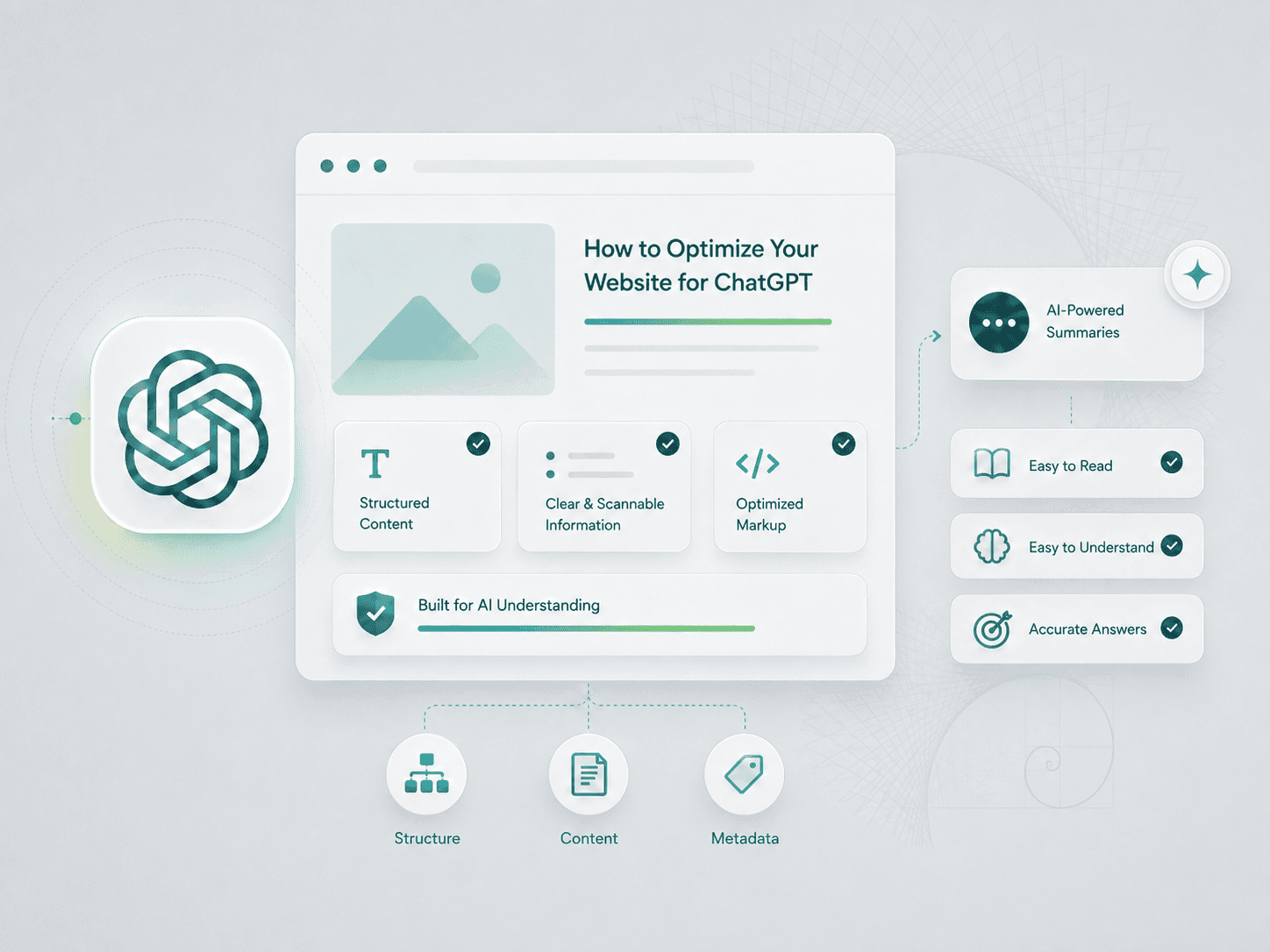
ChatGPT Search Optimization: How to Get Found in ChatGPT
Learn ChatGPT search optimization strategies...

GEO vs SEO
What's the Difference Between GEO and SEO?
SEO and GEO both improve online visibility...
